How a rule-based chatbot learned to improvise
Over two years at KBC, I designed conversations for Kate, the digital assistant inside Belgium's best-rated banking app. My focus: business and third-party integrations. The challenge that defined the project: how do you blend predictable, rule-based conversations with unpredictable LLM-generated answers, without the user noticing the seam?
- My role
- UX / Conversational DesignerBusiness and third-party services in Kate
- When
- Dec 2022 to Mar 2025and again from Mar 2026
- With
- KBCvia iO, then freelance
- Outcome
- World's best banking app, 2024Belgium's best digital assistant, out of 65
The context
Kate has been part of KBC Mobile for years, a rule-based assistant that handles around 21,500 questions per day. To put that in perspective: that's roughly the capacity of the AFAS Dome, Belgium's largest arena. When I joined, she could recognize what users were asking and route them through predefined conversation flows. It worked well for straightforward banking queries.
But for third-party integrations, things like parking payments, mobility services, and external partner features, rigid scripts weren't enough. Users asked questions in ways we couldn't fully predict, about services with documentation that changed frequently. That's where the opportunity was.
The design challenge
The existing recognition layer, the part that understands what you're saying, couldn't be changed. It was the foundation everything else ran on. So whatever we built had to work within that architecture.
When someone typed "how do I pay for parking?", the rule-based system recognized the intent and identified it as a third-party topic. From there, we fed the relevant documentation from KBC's website into an LLM to generate a contextual answer. The flow went from deterministic to probabilistic mid-conversation, and the user shouldn't feel the shift.
That was the hard part. A rule-based response is the same every time. An LLM response isn't. Designing a conversation that moves smoothly from one to the other, without feeling broken or inconsistent, meant rethinking how we structured transitions, managed expectations, and handled edge cases where the LLM might not have a good answer.
Transparency by design
We also had to get the ethics right. The European Accessibility Act requires full transparency about AI use. Users need to know when they're reading something generated by a machine versus something written by a human.
I designed a custom text bubble specifically for LLM-generated answers, visually distinct from Kate's standard responses. It made clear that this answer was AI-generated, gave users context about where the information came from, and maintained trust in a space where people are making financial decisions. Transparency wasn't an afterthought, it was a core design constraint.
Designing the ATM locator
The work went beyond the chat bubble. I also designed the in-app experiences Kate hands you off to. One I'm fond of: finding cash. Ask Kate "where can I find an ATM around here?" and she surfaces a Find an ATM action. Tapping it opens a map of nearby cash points, clustered by area, and opening one shows its address, opening hours, and exactly what it can and can't do, withdrawals, deposits, PIN change, even whether it has an audio function.
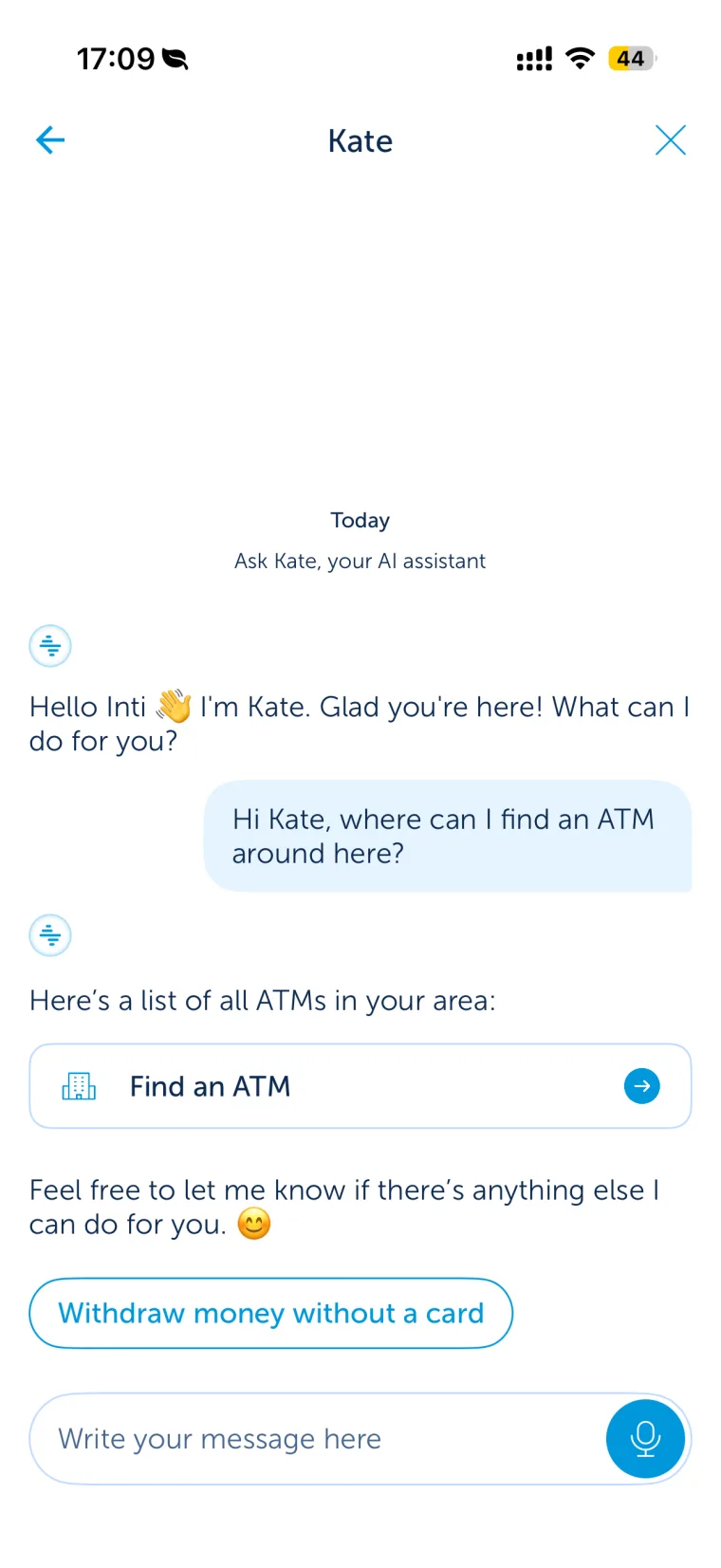
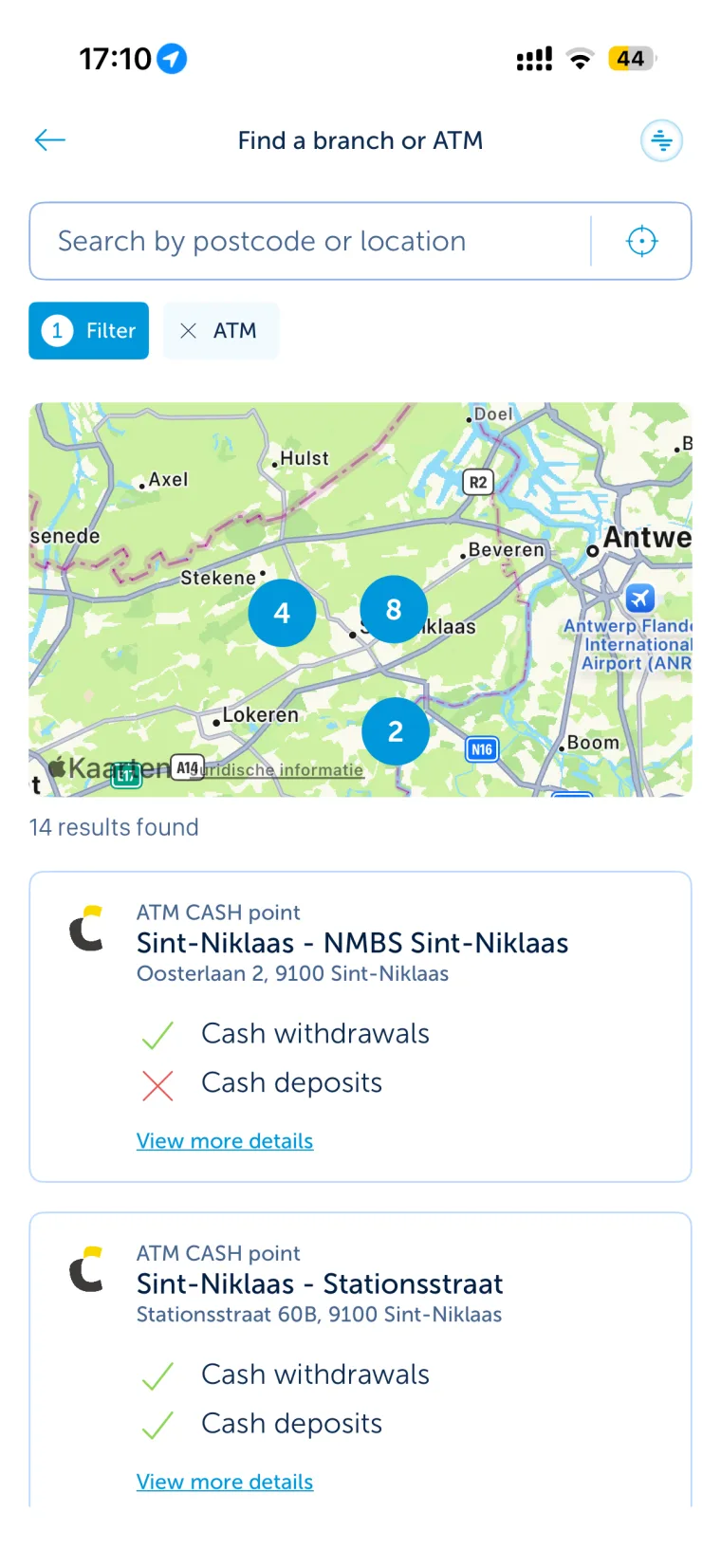
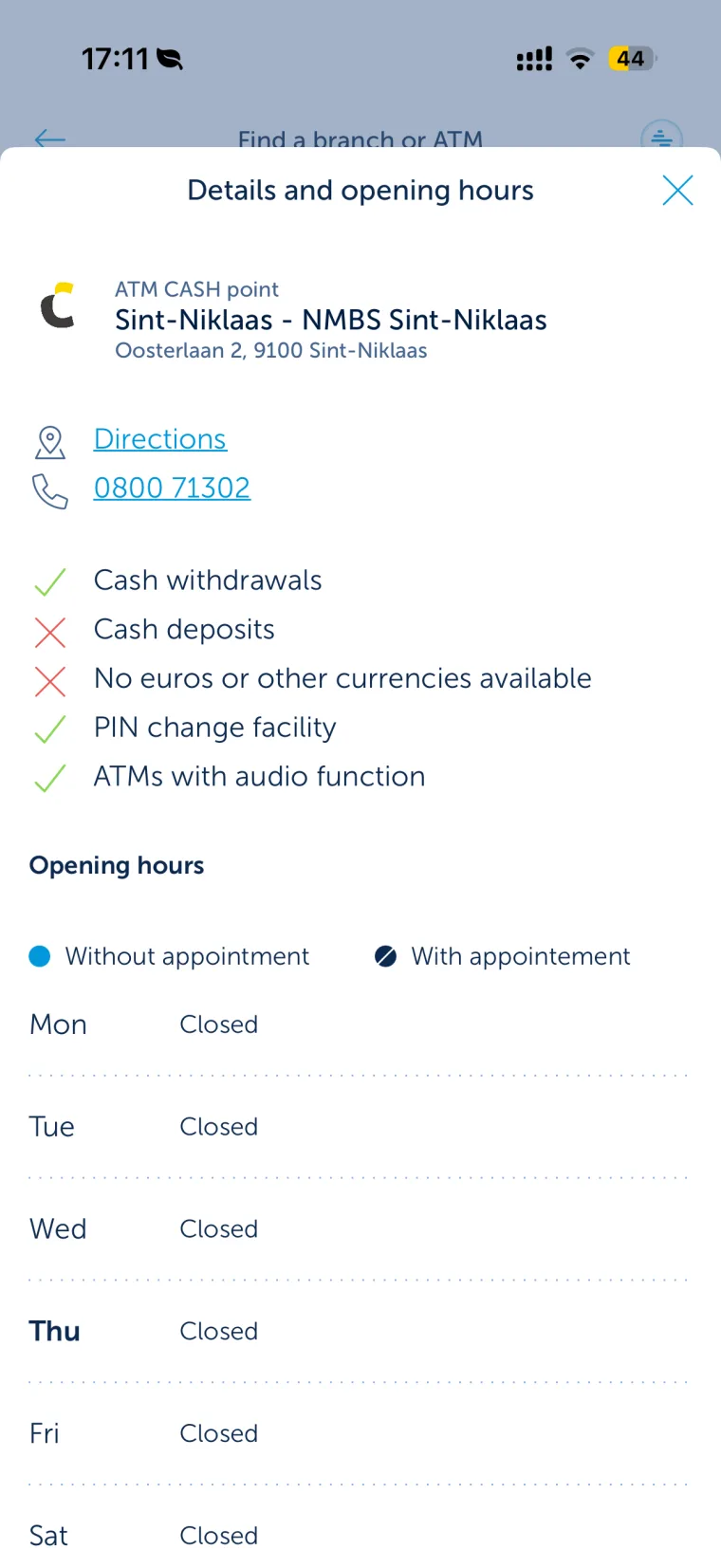
The design goal was continuity: the jump from a chat message to a full-screen map to a detail view should feel like one experience, not three screens bolted together.
My role
I acted as the connective tissue between Product Owners, Business, Engineering, and UI Design, translating requirements into workable scope and keeping cross-functional teams aligned and on deadline. I was part of the core team that brought the first LLM experiments into what was then a fully rule-based system.
Day to day, that meant designing conversation flows, defining scope for third-party integrations, writing and improving knowledge bases, building proactive conversations that reached out to users at the right moment, and creating business dashboards to track how conversations were performing.
I was not the Product Owner, I didn't own the roadmap or set OKRs. But I consistently operated in the PO's orbit, carrying coordination and strategic initiative responsibilities that went well beyond a typical design role.
The results
- World's best banking app, SIA Partners, 2024
- Best digital assistant in Belgium, out of 65 compared, Campfire AI, 2023 & 2025
- Highest rating for design & accessibility, Campfire AI, 2024
What I learned
The biggest lesson: the best AI experiences aren't about the AI. They're about the transitions, the moments where the system shifts from one mode to another. Get those right, and users don't even notice. Get them wrong, and the whole thing feels broken.
I gave a talk at UX Beers about this exact transition, from rule-based to LLM-powered conversations, and what it means for designers working with AI.
Need this on your team?
This is the kind of work I do embedded in a team, days per week.
Consultancy
Next case
VRT MAX
Launched for the FIFA World Cup →